
Key Statistics
30%Average fuel cost reduction with FMS implementation | 2–5%Typical fuel loss in unmonitored mine sites | 24/7Real-time monitoring capability of modern FMS |
How intelligent fuel oversight is cutting costs, improving safety, and driving sustainability across modern mining operations.
In the mining industry, fuel is one of the largest operational expenses — often accounting for 30 to 40 percent of total operating costs. Haul trucks, excavators, drilling rigs, generators, and auxiliary vehicles consume enormous quantities of diesel and other fuels around the clock. Without disciplined oversight, inefficiencies, theft, and misuse can silently drain millions of dollars from a mine's annual budget.
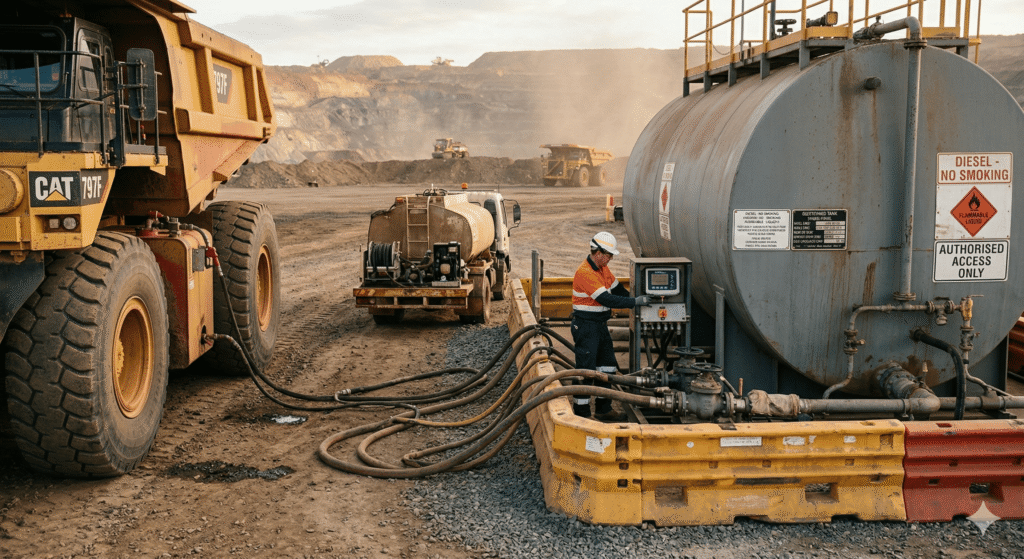
A Fuel Management System (FMS) is a technology platform designed to monitor, control, and optimise every aspect of fuel consumption across a mining operation. From automated dispensing at the refuelling station to real-time telemetry from heavy equipment, modern FMS solutions provide mine managers with unprecedented visibility into how fuel moves through their operations.
Fuel is the lifeblood of any mining operation — and knowing exactly where every litre goes is the foundation of operational excellence.
Core Components of a Mining FMS
A well-designed fuel management system is not a single device — it is an integrated ecosystem of hardware, software, and connectivity layers working in concert.
- Automated Dispensing Units
Smart fuel pumps with RFID or PIN authentication that log every transaction — who refuelled, how much, which vehicle, and when.
- Real-Time Telemetry
Onboard sensors and GPS transmitters relay live fuel levels, consumption rates, and engine data from every asset in the fleet.
- Centralised Dashboard
A unified software interface giving operations teams live visibility, historical reporting, and alert management from a single view.
- Tank Level Monitoring
Ultrasonic or pressure sensors in bulk storage tanks provide continuous level readings, detecting leaks or discrepancies automatically.
- Exception & Alert Engine
Rule-based triggers that fire alerts for anomalous consumption, unauthorised access, low stock levels, or potential theft events.
- Analytics & Reporting
Automated reports on fuel efficiency per asset, shift, operator, or cost centre — powering better maintenance and procurement planning.
Why Fuel Management Matters in Mining
Scale of fuel consumption
A large open-cut mine may operate hundreds of vehicles simultaneously. A single 300-tonne haul truck can consume over 100 litres of diesel per hour at full load. Multiply this across an entire fleet running multiple shifts, and it becomes immediately clear why fuel represents such a significant cost centre. At this scale, even a 5% reduction in fuel waste translates directly to millions of dollars in annual savings.
Theft and unauthorised use
Remote mine sites present real security vulnerabilities. Without automated controls, fuel can be siphoned from storage tanks or dispensed to personal vehicles without any record. Industry data suggests that unmonitored sites lose between 2 and 5 percent of their total fuel volume to theft or unauthorised use. FMS systems with RFID authentication, transaction logging, and camera integration provide a robust deterrent and audit trail.
Regulatory and environmental compliance
Mining companies face growing pressure to report Scope 1 greenhouse gas emissions accurately. Precise fuel consumption data — broken down by equipment type, operational zone, and time period — is the foundation of credible emissions accounting. Regulators and investors increasingly expect this level of granularity, and an FMS automates the data collection required to meet these obligations.
Operational Benefits
- Cost control: Precise tracking eliminates unaccounted fuel losses and enables managers to benchmark consumption against production targets, identifying inefficient equipment before the problem compounds.
- Predictive maintenance: Abnormal fuel consumption is often an early indicator of engine problems such as a degraded injector or a blocked air filter. FMS analytics surface these signals before they become costly breakdowns.
- Procurement optimisation: Accurate inventory data enables procurement teams to schedule deliveries precisely, reducing the risk of costly emergency orders or excess stock tying up working capital.
- Operator accountability: Tying fuel transactions to individual operators creates a culture of responsibility and enables targeted training for those with consistently inefficient driving behaviour.
- Safety improvement: Monitoring fuel storage conditions — temperature, pressure, and level — reduces the risk of hazardous spills or undetected leaks that could create fire or environmental incidents.
- Emissions reporting: Automated calculation of CO2-equivalent emissions per asset supports ESG reporting and helps mines track progress against decarbonisation targets.
Implementation Challenges
Despite the clear benefits, deploying an FMS across a mining operation is not without complexity. Mine operators should anticipate and plan for the following challenges.
Key implementation Challenges
- Connectivity in remote or underground environments — reliable cellular or radio networks are not always available across an entire mine site
- Integration with existing fleet management, ERP, and maintenance systems — data silos can limit the analytical value of an FMS
- Hardware ruggedness — mining environments subject sensors and dispensing equipment to extreme dust, vibration, heat, and humidity
- Change management — operators and supervisors need training and buy-in; resistance to monitoring is a common human factor
- Data quality and calibration — sensor drift and incorrect vehicle configurations can introduce errors that undermine trust in the system
- Multi-contractor environments — different fleets operating under different owners on the same site can complicate data ownership and access
The Road Ahead: Emerging Trends
The evolution of fuel management in mining is accelerating, driven by advances in connectivity, artificial intelligence, and the energy transition.
AI & Machine Learning
AI & Machine Learning Predictive models that forecast fuel demand and flag anomalies automatically, without needing manual rule configuration.
Alternative Fuels
FMS platforms are expanding to track hydrogen, biodiesel, and electric energy consumption as mining fleets diversify their power sources.
Autonomous Haulage
Self-driving trucks can be programmed with fuel-optimised routing in real time, with the FMS providing closed-loop feedback.
Conclusion
A fuel management system is no longer an optional add-on for mining operations — it is a fundamental pillar of financial discipline, safety management, and environmental accountability. As fuel costs remain volatile and regulatory expectations intensify, mine operators who invest in robust FMS infrastructure will be better positioned to manage risk, reduce waste, and demonstrate credible progress toward sustainability goals. The mines of the future will be defined not just by what they extract from the earth, but by how intelligently they manage every resource that keeps them running.